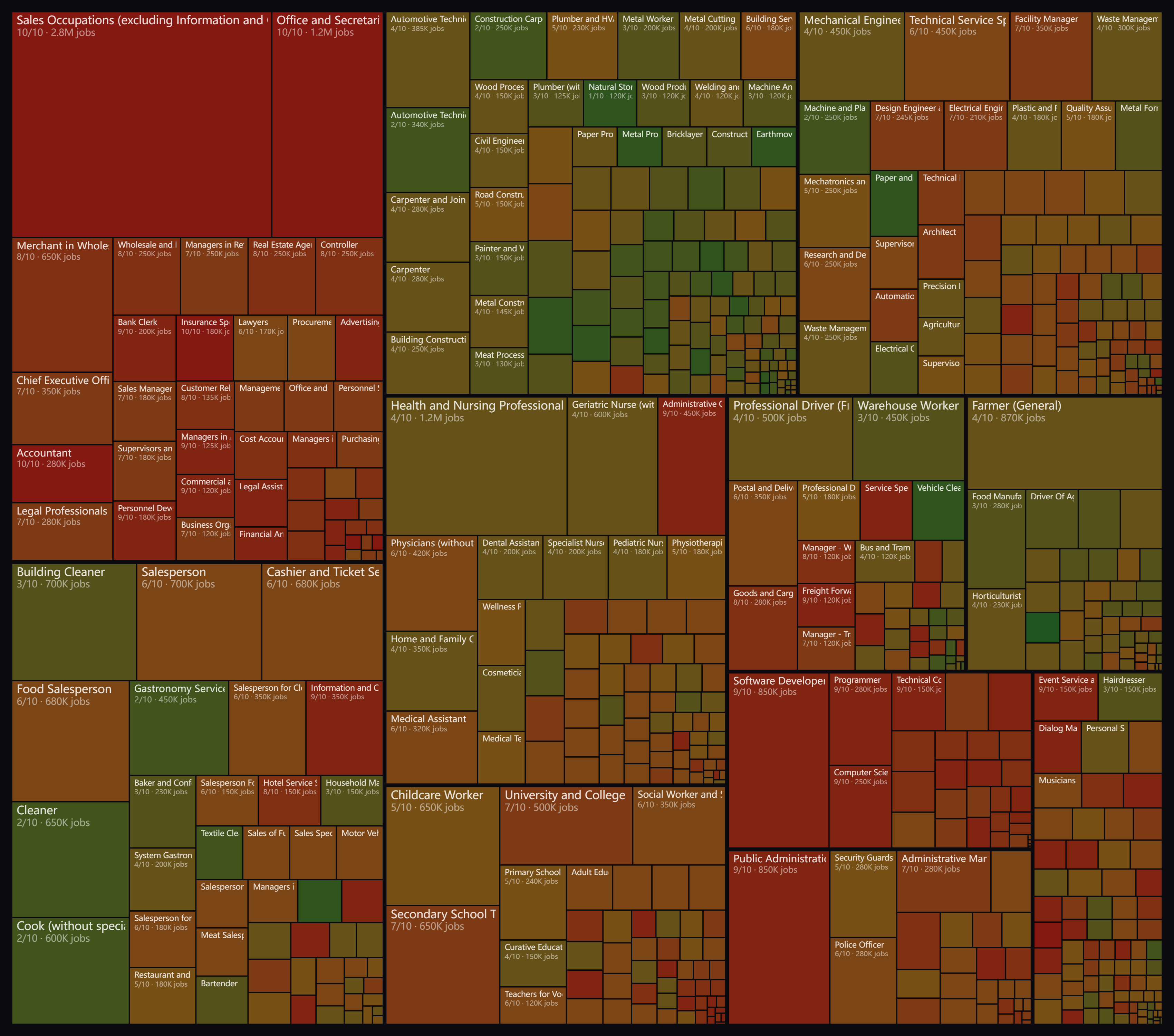
AI job risk in Germany
Generative AI exposure across the German job market is measured on a scale of 0 to 10, where higher scores indicate tasks that are more susceptible to being reshaped by AI. The assessment covers 653 distinct occupations and 55,164,100 workers. The employment-weighted average exposure score for Germany is 5.8, placing the country around the midpoint of the scale. This means that, on average, tasks in the German economy have a moderate degree of overlap with capabilities of generative AI. It is important to note that exposure refers to the potential for AI to augment or automate specific tasks, not a direct prediction of job losses. Instead, the score highlights where generative AI is likely to first influence how work is done.
Occupations with the highest exposure include sales roles (excluding ICT), office clerks, accountants, insurance specialists, market researchers, tax consultants, stenographers, and public administration officers, all scoring 9 or 10. These roles involve significant data processing, documentation, analysis, or routine administrative tasks—areas where generative AI is already proficient. Industries with the highest average exposure are business, finance, and legal (8.8); IT and digital (8.5); government and public sector (7.2); creative, media, and personal services (6.4); and education and community (6.1). At the other end of the spectrum, occupations requiring manual dexterity, physical presence, or specialised hands-on skills—such as florists, vehicle cleaners, floor layers, and construction workers—score 0 or 1. These roles involve tasks that are difficult for AI to replicate, such as handling delicate materials, operating heavy machinery, or providing in-person services.
20 jobs most exposed to AI in Germany
| # | Occupation | Code | Exposure | Average annual pay | Employed |
|---|---|---|---|---|---|
| 1 | Sales Occupations (excluding Information and Communication Technologies) | 6112 | 10/10 | €72,672 | 2,800,000 |
| 2 | Office and Secretarial Clerk (General) | 7140 | 10/10 | €52,320 | 1,200,000 |
| 3 | Accountant | 7221 | 10/10 | €69,612 | 280,000 |
| 4 | Insurance Specialist (Versicherungskaufleute) | 7213 | 10/10 | €73,728 | 180,000 |
| 5 | Market and Opinion Researcher | 9134 | 10/10 | €59,664 | 35,000 |
| 6 | Tax Consultant | 7230 | 10/10 | €60,564 | 11,000 |
| 7 | Stenographer and Phonotypist | 7143 | 10/10 | €52,320 | 8,000 |
| 8 | Public Administration Officer (General) | 7320 | 9/10 | €60,456 | 850,000 |
| 9 | Software Developer | 4341 | 9/10 | €73,656 | 850,000 |
| 10 | Administrative Occupations in Social and Health Care | 7322 | 9/10 | €60,456 | 450,000 |
| 11 | Information and Customer Service Agent | 7145 | 9/10 | €52,320 | 350,000 |
| 12 | Programmer | 4342 | 9/10 | €73,656 | 280,000 |
| 13 | Computer Scientist (General) | 4310 | 9/10 | €72,096 | 250,000 |
| 14 | Bank Clerk | 7211 | 9/10 | €73,728 | 200,000 |
| 15 | Personnel Development and Administration Specialist | 7151 | 9/10 | €68,304 | 180,000 |
| 16 | Advertising and Marketing Professional | 9211 | 9/10 | €66,876 | 150,000 |
| 17 | Event Service and Management Professionals | 6340 | 9/10 | €48,780 | 150,000 |
| 18 | Technical Computer Scientist | 4312 | 9/10 | €72,096 | 150,000 |
| 19 | Service Specialist in Road and Rail Transport | 5141 | 9/10 | €45,420 | 150,000 |
| 20 | Managers in Advertising and Marketing | 9219 | 9/10 | €66,876 | 125,000 |
20 jobs least exposed to AI in Germany
| # | Occupation | Code | Exposure | Average annual pay | Employed |
|---|---|---|---|---|---|
| 1 | Florist | 1220 | 0/10 | €32,952 | 50,000 |
| 2 | Paper and Packaging Technologist | 2310 | 1/10 | €47,256 | 150,000 |
| 3 | Vehicle Cleaner | 5415 | 1/10 | €35,700 | 150,000 |
| 4 | Natural Stone And Mineral Processing And Building Materials Production Worker | 2120 | 1/10 | €45,312 | 120,000 |
| 5 | Floor Layer | 3310 | 1/10 | €41,904 | 120,000 |
| 6 | Glass And Window Cleaner | 5412 | 1/10 | €35,700 | 90,000 |
| 7 | Metal Production Worker (Without Specialization) | 2410 | 1/10 | €49,956 | 85,000 |
| 8 | Earthmoving And Related Machine Operators | 5252 | 1/10 | €45,132 | 85,000 |
| 9 | Tile, Slab and Mosaic Layers | 3311 | 1/10 | €41,904 | 65,000 |
| 10 | Vehicle Painters | 2221 | 1/10 | €46,488 | 35,000 |
| 11 | Furnace And Air Heating Construction Specialist | 3422 | 1/10 | €49,272 | 32,000 |
| 12 | Paving Stone Layer | 3221 | 1/10 | €51,828 | 25,000 |
| 13 | Blind and Shutter Installer | 3335 | 1/10 | €43,344 | 25,000 |
| 14 | Screed and Terrazzo Layers | 3312 | 1/10 | €41,904 | 18,000 |
| 15 | Industrial Glass Blower (Manual) | 2133 | 1/10 | €43,212 | 5,000 |
| 16 | Chimney Builders | 3213 | 1/10 | €46,536 | 5,000 |
| 17 | Cleaner | 5410 | 2/10 | €35,700 | 650,000 |
| 18 | Cook (without specialization) | 2930 | 2/10 | €37,320 | 600,000 |
| 19 | Gastronomy Service Worker | 6330 | 2/10 | €35,868 | 450,000 |
| 20 | Automotive Technician | 2520 | 2/10 | €52,656 | 340,000 |
AI exposure by industry
| Industry | Occupations | Employed | Avg. exposure |
|---|---|---|---|
| Business, Finance & Legal | 47 | 9,724,500 | 9/10 |
| IT & Digital | 30 | 2,559,100 | 9/10 |
| Government & Public Sector | 27 | 2,537,500 | 7/10 |
| Creative, Media & Personal Services | 77 | 2,186,000 | 6/10 |
| Education & Community | 52 | 3,878,400 | 6/10 |
| Transport, Logistics & Mining | 39 | 3,103,700 | 5/10 |
| Engineering & Infrastructure | 96 | 6,643,000 | 5/10 |
| Healthcare & Care | 68 | 6,288,000 | 5/10 |
| Hospitality, Retail & Tourism | 47 | 8,174,000 | 5/10 |
| Agriculture & Environment | 47 | 2,570,900 | 4/10 |
| Trades & Construction | 123 | 7,499,000 | 3/10 |
Explore more
Frequently asked questions
How much AI risk do jobs in Germany face?
Across 653 occupations covering about 55,164,100 workers, Germany has an employment-weighted average generative-AI exposure of 5.8 on a 0–10 scale — an elevated level. A higher score means a larger share of a role's day-to-day tasks can already be performed or assisted by AI.
Which jobs in Germany are most at risk from AI?
The most exposed occupations in Germany are Sales Occupations (excluding Information and Communication Technologies), Office and Secretarial Clerk (General), Accountant, Insurance Specialist (Versicherungskaufleute), Market and Opinion Researcher. These are roles built around routine information work — writing, data handling and analysis — that large language models already handle well.
Which jobs in Germany are least exposed to AI?
The least exposed occupations include Florist, Paper and Packaging Technologist, Vehicle Cleaner. Physical, hands-on and in-person tasks are much harder for current AI to automate, so these roles score low.
Does a high AI exposure score mean the job will be lost?
No. Exposure measures how much of a role's tasks AI can perform or assist with — not whether the job will disappear. A high score flags where AI is most likely to reshape tasks first, and where workers may benefit from building complementary skills.
Which industries in Germany are most exposed to AI?
By employment-weighted average exposure, the most exposed industries in Germany are Business, Finance & Legal, IT & Digital, Government & Public Sector.
How is the AI exposure score calculated?
Every occupation is scored 0–10 by combining two published research datasets — the ILO's Working Paper 140 index and OpenAI's ‘GPTs are GPTs’ task-exposure study — mapped onto Germany's official occupation classification and ranked on a single global percentile scale so scores stay comparable between countries.
Methodology & sources
Every occupation is scored 0–10 for generative-AI exposure by combining two open, published research datasets — the ILO's Working Paper 140 index and OpenAI's GPTs are GPTs task-exposure study — mapped onto Germany's official occupation classification, then ranked on a single global percentile scale so the numbers stay comparable between countries. Tile area is the size of each occupation's workforce, from official statistics. Full methodology & data sources →
Download / share this map