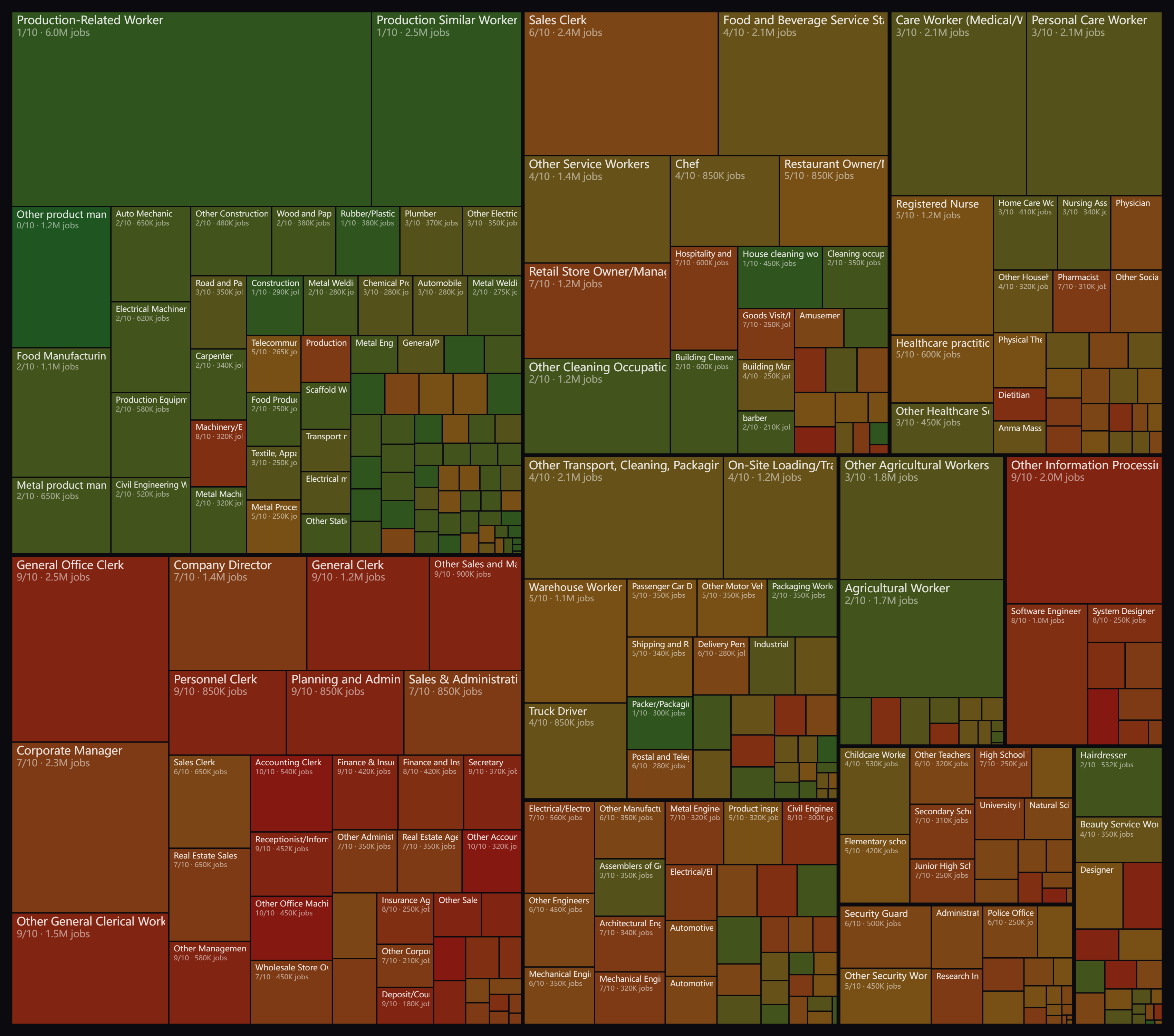
AI job risk in Japan
The Japan job market, with 328 occupations covering over 99 million workers, shows an employment-weighted average generative AI exposure score of 4.8 out of 10. This 0–10 scale measures the degree to which tasks in each occupation can be automated or assisted by generative AI. It is important to note that exposure does not equate to job loss; it indicates where AI is most likely to reshape tasks first, potentially changing how work is done rather than eliminating jobs entirely. A score of 4.8 suggests moderate overall exposure, with significant variation across occupations and industries.
Occupations most exposed to generative AI are heavily clerical and data-intensive, such as accounting clerks, data entry operators, and personal computer operators, all scoring 9 or 10 out of 10. These roles involve routine information processing and transaction handling, which are highly suited to AI automation. In contrast, the least exposed occupations, scoring 1 or 0, are predominantly manual and physical, such as product manufacturing workers, packers, and construction machinery operators, where tasks require dexterity, physical presence, or complex manual skills that AI cannot currently replicate. By industry, IT & Digital (8.5) and Business, Finance & Legal (8.2) face the highest exposure, reflecting their reliance on data and cognitive tasks, while industries like manufacturing and construction have lower average scores.
20 jobs most exposed to AI in Japan
| # | Occupation | Code | Exposure | Employed |
|---|---|---|---|---|
| 1 | Accounting Clerk | 263 | 10/10 | 540,000 |
| 2 | Other Office Machine Operators | 319 | 10/10 | 450,000 |
| 3 | Other Accounting Clerks | 269 | 10/10 | 320,000 |
| 4 | Data Entry Operator | 312 | 10/10 | 150,000 |
| 5 | Personal Computer Operator | 311 | 10/10 | 120,000 |
| 6 | General Office Clerk | 257 | 9/10 | 2,500,000 |
| 7 | Other Information Processing and Communication Engineers | 109 | 9/10 | 2,000,000 |
| 8 | Other General Clerical Workers | 259 | 9/10 | 1,500,000 |
| 9 | General Clerk | 251 | 9/10 | 1,200,000 |
| 10 | Other Sales and Marketing Occupations | 349 | 9/10 | 900,000 |
| 11 | Personnel Clerk | 252 | 9/10 | 850,000 |
| 12 | Planning and Administrative Assistant | 253 | 9/10 | 850,000 |
| 13 | Other Management, Finance, and Insurance Professionals | 189 | 9/10 | 580,000 |
| 14 | Receptionist/Information Clerk | 254 | 9/10 | 452,000 |
| 15 | Finance & Insurance Specialist | 184 | 9/10 | 420,000 |
| 16 | Secretary | 255 | 9/10 | 370,000 |
| 17 | Advertising Promoter | 424 | 9/10 | 230,000 |
| 18 | Deposit/Counter Clerk | 262 | 9/10 | 180,000 |
| 19 | Other Sales-Related Occupations | 339 | 9/10 | 180,000 |
| 20 | 電話応接事務員 | 256 | 9/10 | 150,000 |
20 jobs least exposed to AI in Japan
| # | Occupation | Code | Exposure | Employed |
|---|---|---|---|---|
| 1 | Other product manufacturing/processing workers (excluding metal products) | 539 | 0/10 | 1,200,000 |
| 2 | Production-Related Worker | 591 | 1/10 | 6,000,000 |
| 3 | Production Similar Worker | 592 | 1/10 | 2,500,000 |
| 4 | House cleaning worker | 712 | 1/10 | 450,000 |
| 5 | Rubber/Plastic Product Manufacturing Worker | 538 | 1/10 | 380,000 |
| 6 | Packer/Packaging Worker | 706 | 1/10 | 300,000 |
| 7 | Construction & Well-drilling Machinery Operator | 645 | 1/10 | 290,000 |
| 8 | Block Mason and Tiler | 662 | 1/10 | 130,000 |
| 9 | Ceramic, stone and clay product manufacturing workers | 532 | 1/10 | 120,000 |
| 10 | Plasterer | 664 | 1/10 | 120,000 |
| 11 | Metal Press Worker | 524 | 1/10 | 85,000 |
| 12 | Ironworker / Steel Fabrication Worker | 525 | 1/10 | 85,000 |
| 13 | Reinforcing Ironworker | 653 | 1/10 | 80,000 |
| 14 | Sheet Metal Worker | 526 | 1/10 | 68,000 |
| 15 | Sheet Metal Equipment Control/Monitoring Specialist | 496 | 1/10 | 45,000 |
| 16 | Deckhand / Marine Technician | 633 | 1/10 | 45,000 |
| 17 | Other Mining Workers | 699 | 1/10 | 36,000 |
| 18 | Bathhouse Attendant | 384 | 1/10 | 35,000 |
| 19 | Ceramics/Stone Production Equipment Control & Monitor Staff | 502 | 1/10 | 25,000 |
| 20 | Workers Engaged in Gravel, Sand, and Clay Extraction | 693 | 1/10 | 14,000 |
AI exposure by industry
| Industry | Occupations | Employed | Avg. exposure |
|---|---|---|---|
| IT & Digital | 9 | 3,915,000 | 9/10 |
| Business, Finance & Legal | 40 | 20,430,000 | 8/10 |
| Education & Community | 17 | 3,157,000 | 6/10 |
| Engineering & Infrastructure | 33 | 6,034,000 | 6/10 |
| Government & Public Sector | 20 | 2,417,300 | 6/10 |
| Creative, Media & Personal Services | 20 | 2,123,300 | 5/10 |
| Hospitality, Retail & Tourism | 27 | 13,832,000 | 5/10 |
| Transport, Logistics & Mining | 32 | 9,230,000 | 4/10 |
| Healthcare & Care | 31 | 10,333,000 | 4/10 |
| Agriculture & Environment | 14 | 4,103,500 | 3/10 |
| Trades & Construction | 85 | 23,647,300 | 2/10 |
Explore more
Frequently asked questions
How much AI risk do jobs in Japan face?
Across 328 occupations covering about 99,222,400 workers, Japan has an employment-weighted average generative-AI exposure of 4.8 on a 0–10 scale — a moderate level. A higher score means a larger share of a role's day-to-day tasks can already be performed or assisted by AI.
Which jobs in Japan are most at risk from AI?
The most exposed occupations in Japan are Accounting Clerk, Other Office Machine Operators, Other Accounting Clerks, Data Entry Operator, Personal Computer Operator. These are roles built around routine information work — writing, data handling and analysis — that large language models already handle well.
Which jobs in Japan are least exposed to AI?
The least exposed occupations include Other product manufacturing/processing workers (excluding metal products), Production-Related Worker, Production Similar Worker. Physical, hands-on and in-person tasks are much harder for current AI to automate, so these roles score low.
Does a high AI exposure score mean the job will be lost?
No. Exposure measures how much of a role's tasks AI can perform or assist with — not whether the job will disappear. A high score flags where AI is most likely to reshape tasks first, and where workers may benefit from building complementary skills.
Which industries in Japan are most exposed to AI?
By employment-weighted average exposure, the most exposed industries in Japan are IT & Digital, Business, Finance & Legal, Education & Community.
How is the AI exposure score calculated?
Every occupation is scored 0–10 by combining two published research datasets — the ILO's Working Paper 140 index and OpenAI's ‘GPTs are GPTs’ task-exposure study — mapped onto Japan's official occupation classification and ranked on a single global percentile scale so scores stay comparable between countries.
Methodology & sources
Every occupation is scored 0–10 for generative-AI exposure by combining two open, published research datasets — the ILO's Working Paper 140 index and OpenAI's GPTs are GPTs task-exposure study — mapped onto Japan's official occupation classification, then ranked on a single global percentile scale so the numbers stay comparable between countries. Tile area is the size of each occupation's workforce, from official statistics. Full methodology & data sources →
Download / share this map