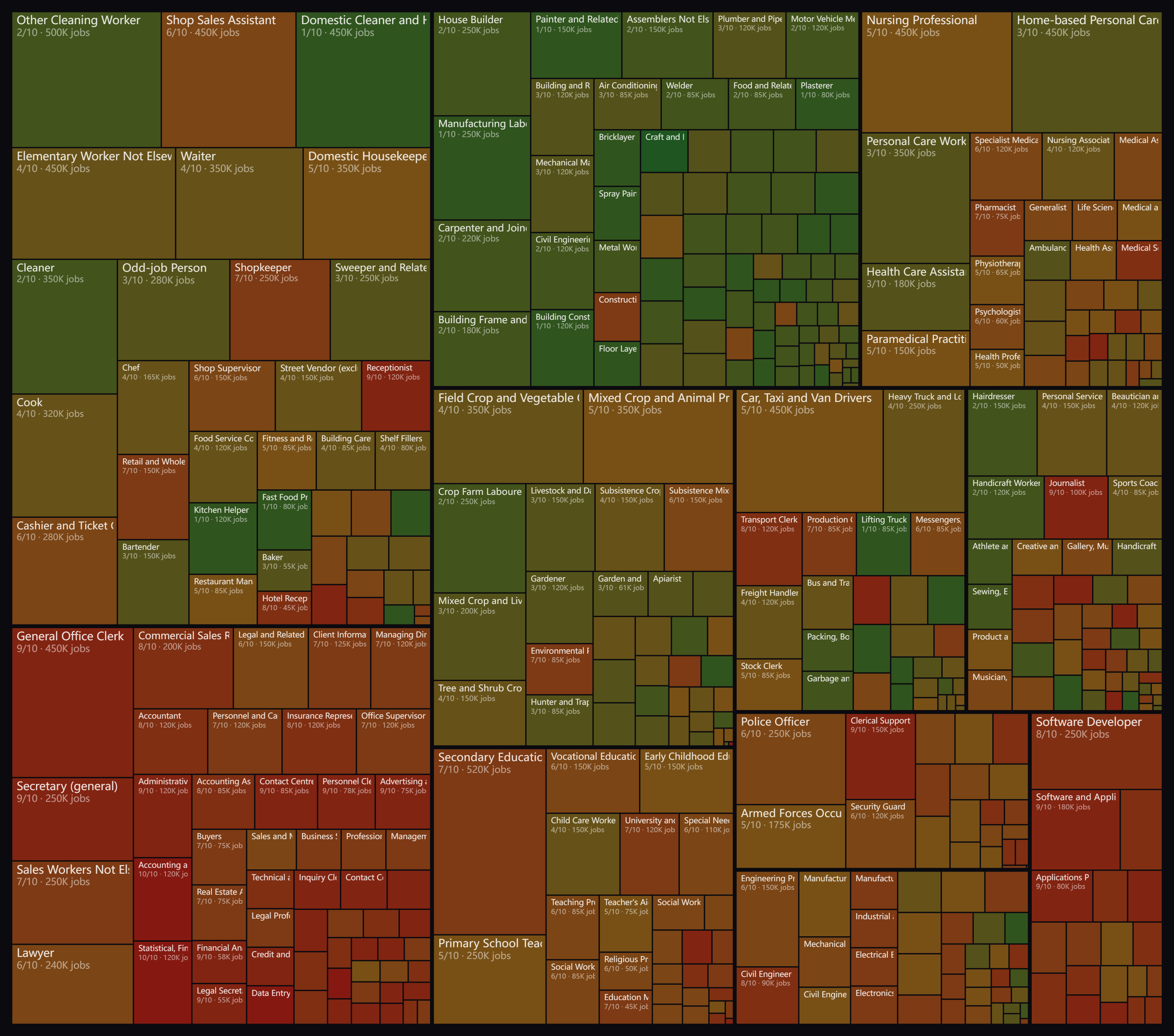
AI job risk in Italy
In Italy, the analysis covers 436 distinct occupations representing 28,475,450 workers, assigning each a task-exposure score on a 0-to-10 scale. The employment-weighted average exposure across the labour market is 4.9, indicating a moderate overall potential for generative AI to reshape tasks. It is important to emphasise that these exposure scores measure the degree to which job tasks could be affected by AI, not the likelihood of job loss. A high score suggests that AI may automate or augment key tasks, while a low score indicates tasks that are harder to automate. The average of 4.9 signals that a substantial share of Italian workers are in roles where generative AI could meaningfully change work processes, but the effect will vary widely by occupation and industry.
Occupations with the highest exposure include accounting clerks, data entry clerks, and secretaries, all scoring 9 or 10 out of 10. These roles involve routine information processing, data handling, and administrative tasks that align closely with current generative AI capabilities. Conversely, the least exposed roles are craft and related workers, domestic cleaners, and manufacturing labourers, scoring 0 or 1. These jobs rely on manual dexterity, physical presence, and non-standard environments that AI cannot easily replicate. At the industry level, IT & Digital and Business, Finance & Legal sectors have the highest average exposure (8.0 each), followed by Government & Public Sector (6.3) and Education & Community (6.0). This pattern underscores that cognitive, office-based tasks are more susceptible to AI influence than manual or hands-on roles.
20 jobs most exposed to AI in Italy
| # | Occupation | Code | Exposure | Average annual pay | Employed |
|---|---|---|---|---|---|
| 1 | Accounting and Bookkeeping Clerk | 4311 | 10/10 | €28,667 | 120,000 |
| 2 | Statistical, Finance and Insurance Clerk | 4312 | 10/10 | €33,667 | 120,000 |
| 3 | Data Entry Clerks | 4132 | 10/10 | €25,500 | 45,000 |
| 4 | Typist and Word Processing Operator | 4131 | 10/10 | €25,500 | 18,000 |
| 5 | Water and Firewood Collectors | 9624 | 10/10 | €9,667 | 500 |
| 6 | General Office Clerk | 4110 | 9/10 | €27,333 | 450,000 |
| 7 | Secretary (general) | 4120 | 9/10 | €27,333 | 250,000 |
| 8 | Software and Applications Developers and Analysts Not Elsewhere Classified | 2519 | 9/10 | €50,500 | 180,000 |
| 9 | Clerical Support Workers Not Elsewhere Classified | 4419 | 9/10 | €27,000 | 150,000 |
| 10 | Administrative and Executive Secretary | 3343 | 9/10 | €30,000 | 120,000 |
| 11 | Receptionist | 4226 | 9/10 | €25,500 | 120,000 |
| 12 | Journalist | 2642 | 9/10 | €35,667 | 100,000 |
| 13 | Contact Centre Information Clerks | 4222 | 9/10 | €25,500 | 85,000 |
| 14 | Applications Programmer | 2514 | 9/10 | €45,500 | 80,000 |
| 15 | Personnel Clerk | 4416 | 9/10 | €30,667 | 78,000 |
| 16 | Advertising and Marketing Professional | 2431 | 9/10 | €46,000 | 75,000 |
| 17 | Financial Analyst | 2413 | 9/10 | €63,333 | 58,000 |
| 18 | Legal Secretary | 3342 | 9/10 | €28,667 | 55,000 |
| 19 | Credit and Loans Officers | 3312 | 9/10 | €40,500 | 45,000 |
| 20 | Inquiry Clerk | 4225 | 9/10 | €27,000 | 45,000 |
20 jobs least exposed to AI in Italy
| # | Occupation | Code | Exposure | Average annual pay | Employed |
|---|---|---|---|---|---|
| 1 | Craft and Related Workers Not Elsewhere Classified | 7549 | 0/10 | €31,333 | 50,000 |
| 2 | Domestic Cleaner and Helper | 9111 | 1/10 | €17,667 | 450,000 |
| 3 | Manufacturing Labourers Not Elsewhere Classified | 9329 | 1/10 | €24,000 | 250,000 |
| 4 | Painter and Related Worker | 7131 | 1/10 | €26,667 | 150,000 |
| 5 | Kitchen Helper | 9412 | 1/10 | €20,167 | 120,000 |
| 6 | Building Construction Labourer | 9313 | 1/10 | €24,333 | 120,000 |
| 7 | Lifting Truck Operators | 8344 | 1/10 | €24,667 | 85,000 |
| 8 | Fast Food Preparer | 9411 | 1/10 | €20,500 | 80,000 |
| 9 | Plasterer | 7123 | 1/10 | €26,667 | 80,000 |
| 10 | Bricklayer | 7112 | 1/10 | €28,667 | 65,000 |
| 11 | Spray Painter and Varnisher | 7132 | 1/10 | €30,833 | 62,000 |
| 12 | Floor Layer and Tile Setter | 7122 | 1/10 | €28,000 | 52,000 |
| 13 | Butcher | 7511 | 1/10 | €25,500 | 45,000 |
| 14 | Cement, Stone and Other Mineral Products Machine Operator | 8114 | 1/10 | €25,833 | 45,000 |
| 15 | Earthmoving and Related Plant Operator | 8342 | 1/10 | €32,167 | 45,000 |
| 16 | Vehicle Cleaner | 9122 | 1/10 | €22,667 | 45,000 |
| 17 | Hand Packers | 9321 | 1/10 | €24,000 | 45,000 |
| 18 | Sheet Metal Worker | 7213 | 1/10 | €32,167 | 35,000 |
| 19 | Concrete Finisher | 7114 | 1/10 | €25,500 | 32,000 |
| 20 | Rubber Products Machine Operator | 8141 | 1/10 | €25,500 | 28,000 |
AI exposure by industry
| Industry | Occupations | Employed | Avg. exposure |
|---|---|---|---|
| IT & Digital | 19 | 1,021,000 | 8/10 |
| Business, Finance & Legal | 56 | 4,095,500 | 8/10 |
| Government & Public Sector | 22 | 1,132,650 | 6/10 |
| Education & Community | 29 | 2,049,200 | 6/10 |
| Engineering & Infrastructure | 36 | 1,118,200 | 6/10 |
| Transport, Logistics & Mining | 30 | 1,824,900 | 5/10 |
| Healthcare & Care | 40 | 2,786,000 | 4/10 |
| Creative, Media & Personal Services | 46 | 1,555,400 | 4/10 |
| Hospitality, Retail & Tourism | 41 | 6,315,000 | 4/10 |
| Agriculture & Environment | 36 | 2,645,400 | 4/10 |
| Trades & Construction | 81 | 3,932,200 | 2/10 |
Explore more
Frequently asked questions
How much AI risk do jobs in Italy face?
Across 436 occupations covering about 28,475,450 workers, Italy has an employment-weighted average generative-AI exposure of 4.9 on a 0–10 scale — a moderate level. A higher score means a larger share of a role's day-to-day tasks can already be performed or assisted by AI.
Which jobs in Italy are most at risk from AI?
The most exposed occupations in Italy are Accounting and Bookkeeping Clerk, Statistical, Finance and Insurance Clerk, Data Entry Clerks, Typist and Word Processing Operator, Water and Firewood Collectors. These are roles built around routine information work — writing, data handling and analysis — that large language models already handle well.
Which jobs in Italy are least exposed to AI?
The least exposed occupations include Craft and Related Workers Not Elsewhere Classified, Domestic Cleaner and Helper, Manufacturing Labourers Not Elsewhere Classified. Physical, hands-on and in-person tasks are much harder for current AI to automate, so these roles score low.
Does a high AI exposure score mean the job will be lost?
No. Exposure measures how much of a role's tasks AI can perform or assist with — not whether the job will disappear. A high score flags where AI is most likely to reshape tasks first, and where workers may benefit from building complementary skills.
Which industries in Italy are most exposed to AI?
By employment-weighted average exposure, the most exposed industries in Italy are IT & Digital, Business, Finance & Legal, Government & Public Sector.
How is the AI exposure score calculated?
Every occupation is scored 0–10 by combining two published research datasets — the ILO's Working Paper 140 index and OpenAI's ‘GPTs are GPTs’ task-exposure study — mapped onto Italy's official occupation classification and ranked on a single global percentile scale so scores stay comparable between countries.
Methodology & sources
Every occupation is scored 0–10 for generative-AI exposure by combining two open, published research datasets — the ILO's Working Paper 140 index and OpenAI's GPTs are GPTs task-exposure study — mapped onto Italy's official occupation classification, then ranked on a single global percentile scale so the numbers stay comparable between countries. Tile area is the size of each occupation's workforce, from official statistics. Full methodology & data sources →
Download / share this map