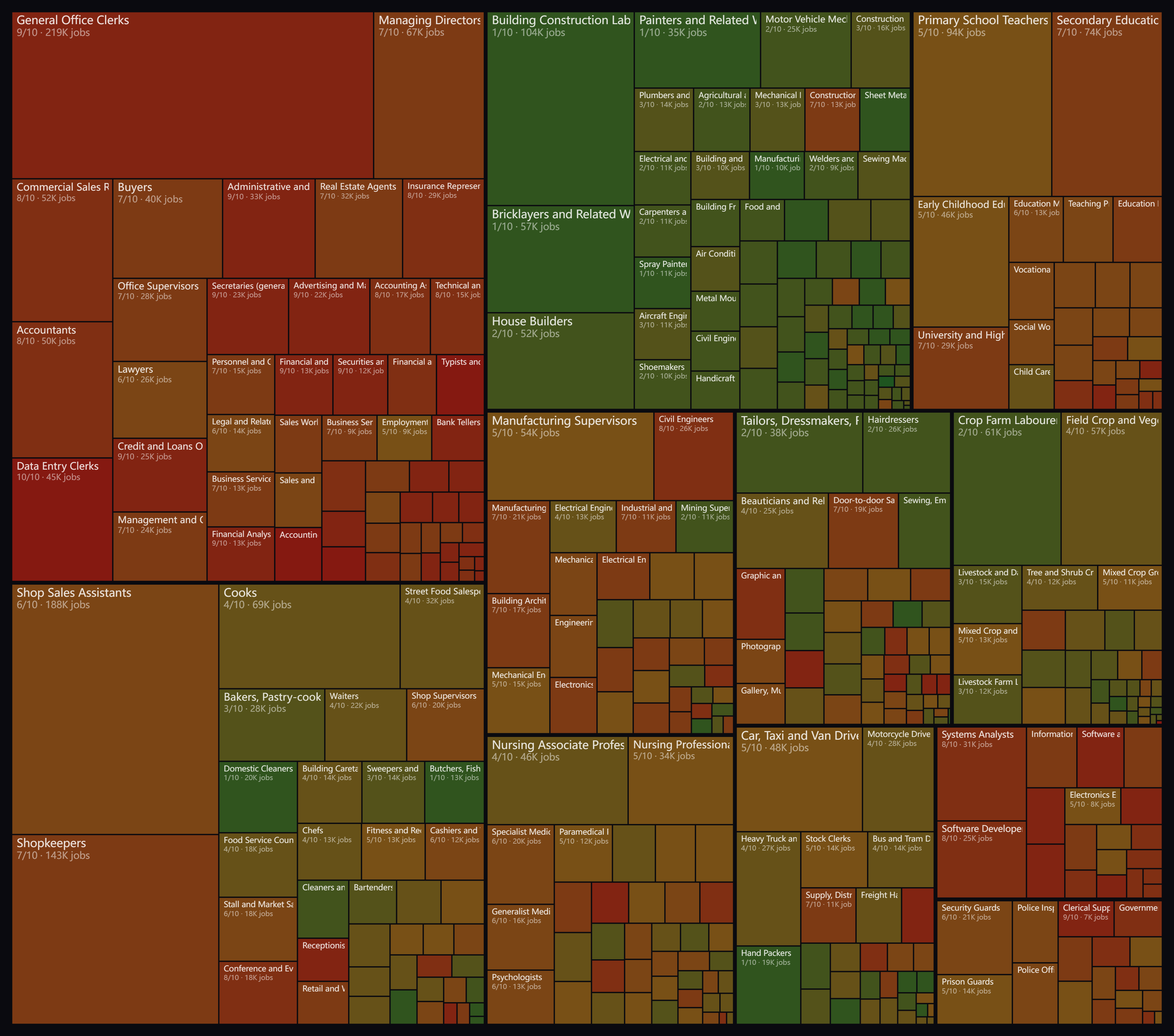
AI job risk in Austria
Across 436 occupations covering about 4,195,998 workers, Austria's labour market carries a elevated average exposure to generative AI of 5.4 on a 0–10 scale, weighted by how many people each occupation employs. Every score maps an occupation onto the ILO and OpenAI research indices, so a higher number means more of the role's day-to-day tasks can already be performed or assisted by AI.
The most exposed roles are Data Entry Clerks, Typists and Word Processing Operators, Accounting and Bookkeeping Clerks — jobs built around routine information work that large language models handle well. The least exposed include Craft and Related Workers Not Elsewhere Classified, Building Construction Labourers, Bricklayers and Related Workers, where physical, in-person or hands-on tasks dominate. By industry, Business, Finance & Legal, IT & Digital sit toward the top of the range. Exposure is not the same as job loss: it flags where AI is most likely to reshape tasks first, and where workers may want to build complementary skills.
20 jobs most exposed to AI in Austria
| # | Occupation | Code | Exposure | Employed |
|---|---|---|---|---|
| 1 | Data Entry Clerks | 4132 | 10/10 | 45,192 |
| 2 | Typists and Word Processing Operators | 4131 | 10/10 | 10,504 |
| 3 | Accounting and Bookkeeping Clerks | 4311 | 10/10 | 9,191 |
| 4 | Statistical, Finance and Insurance Clerks | 4312 | 10/10 | 5,471 |
| 5 | Water and Firewood Collectors | 9624 | 10/10 | 82 |
| 6 | General Office Clerks | 4110 | 9/10 | 218,935 |
| 7 | Administrative and Executive Secretaries | 3343 | 9/10 | 33,357 |
| 8 | Credit and Loans Officers | 3312 | 9/10 | 25,144 |
| 9 | Secretaries (general) | 4120 | 9/10 | 22,500 |
| 10 | Advertising and Marketing Professionals | 2431 | 9/10 | 22,436 |
| 11 | Financial Analysts | 2413 | 9/10 | 13,355 |
| 12 | Financial and Investment Advisers | 2412 | 9/10 | 12,767 |
| 13 | Securities and Finance Dealers and Brokers | 3311 | 9/10 | 12,034 |
| 14 | Software and Applications Developers and Analysts Not Elsewhere Classified | 2519 | 9/10 | 10,544 |
| 15 | Bank Tellers and Related Clerks | 4211 | 9/10 | 8,685 |
| 16 | Receptionists (general) | 4226 | 9/10 | 8,015 |
| 17 | Web and Multimedia Developers | 2513 | 9/10 | 7,950 |
| 18 | Applications Programmers | 2514 | 9/10 | 7,625 |
| 19 | Clerical Support Workers Not Elsewhere Classified | 4419 | 9/10 | 7,473 |
| 20 | Clearing and Forwarding Agents | 3331 | 9/10 | 6,605 |
20 jobs least exposed to AI in Austria
| # | Occupation | Code | Exposure | Employed |
|---|---|---|---|---|
| 1 | Craft and Related Workers Not Elsewhere Classified | 7549 | 0/10 | 642 |
| 2 | Building Construction Labourers | 9313 | 1/10 | 103,672 |
| 3 | Bricklayers and Related Workers | 7112 | 1/10 | 57,302 |
| 4 | Painters and Related Workers | 7131 | 1/10 | 35,029 |
| 5 | Domestic Cleaners and Helpers | 9111 | 1/10 | 20,364 |
| 6 | Hand Packers | 9321 | 1/10 | 18,551 |
| 7 | Butchers, Fishmongers and Related Food Preparers | 7511 | 1/10 | 13,395 |
| 8 | Sheet Metal Workers | 7213 | 1/10 | 11,640 |
| 9 | Spray Painters and Varnishers | 7132 | 1/10 | 10,580 |
| 10 | Manufacturing Labourers Not Elsewhere Classified | 9329 | 1/10 | 9,549 |
| 11 | Plasterers | 7123 | 1/10 | 6,591 |
| 12 | Floor Layers and Tile Setters | 7122 | 1/10 | 5,282 |
| 13 | Rubber Products Machine Operators | 8141 | 1/10 | 4,068 |
| 14 | Kitchen Helpers | 9412 | 1/10 | 3,376 |
| 15 | Structural Metal Preparers and Erectors | 7214 | 1/10 | 2,988 |
| 16 | Lifting Truck Operators | 8344 | 1/10 | 2,826 |
| 17 | Potters and Related Workers | 7314 | 1/10 | 2,809 |
| 18 | Earthmoving and Related Plant Operators | 8342 | 1/10 | 2,541 |
| 19 | Stonemasons, Stone Cutters, Splitters and Carvers | 7113 | 1/10 | 2,278 |
| 20 | Concrete Placers, Concrete Finishers and Related Workers | 7114 | 1/10 | 1,805 |
AI exposure by industry
| Industry | Occupations | Employed | Avg. exposure |
|---|---|---|---|
| Business, Finance & Legal | 56 | 974,820 | 8/10 |
| IT & Digital | 19 | 142,046 | 8/10 |
| Government & Public Sector | 22 | 103,196 | 6/10 |
| Education & Community | 29 | 361,517 | 6/10 |
| Engineering & Infrastructure | 36 | 289,625 | 6/10 |
| Hospitality, Retail & Tourism | 41 | 754,413 | 5/10 |
| Healthcare & Care | 40 | 259,580 | 5/10 |
| Transport, Logistics & Mining | 30 | 215,684 | 4/10 |
| Creative, Media & Personal Services | 46 | 244,955 | 4/10 |
| Agriculture & Environment | 36 | 238,986 | 4/10 |
| Trades & Construction | 81 | 611,176 | 2/10 |
Explore more
Frequently asked questions
How much AI risk do jobs in Austria face?
Across 436 occupations covering about 4,195,998 workers, Austria has an employment-weighted average generative-AI exposure of 5.4 on a 0–10 scale — an elevated level. A higher score means a larger share of a role's day-to-day tasks can already be performed or assisted by AI.
Which jobs in Austria are most at risk from AI?
The most exposed occupations in Austria are Data Entry Clerks, Typists and Word Processing Operators, Accounting and Bookkeeping Clerks, Statistical, Finance and Insurance Clerks, Water and Firewood Collectors. These are roles built around routine information work — writing, data handling and analysis — that large language models already handle well.
Which jobs in Austria are least exposed to AI?
The least exposed occupations include Craft and Related Workers Not Elsewhere Classified, Building Construction Labourers, Bricklayers and Related Workers. Physical, hands-on and in-person tasks are much harder for current AI to automate, so these roles score low.
Does a high AI exposure score mean the job will be lost?
No. Exposure measures how much of a role's tasks AI can perform or assist with — not whether the job will disappear. A high score flags where AI is most likely to reshape tasks first, and where workers may benefit from building complementary skills.
Which industries in Austria are most exposed to AI?
By employment-weighted average exposure, the most exposed industries in Austria are Business, Finance & Legal, IT & Digital, Government & Public Sector.
How is the AI exposure score calculated?
Every occupation is scored 0–10 by combining two published research datasets — the ILO's Working Paper 140 index and OpenAI's ‘GPTs are GPTs’ task-exposure study — mapped onto Austria's official occupation classification and ranked on a single global percentile scale so scores stay comparable between countries.
Data sources & authority for Austria
Employment (tile area) for Austria comes from Statistics Austria (Statistik Austria), classified in ISCO-08. Counts are drawn from the harmonised EU Labour Force Survey published by Eurostat (the European Union’s official statistical authority); occupation detail is modelled from published major-group shares. Pay is not published at occupation level for this source, so salary is left blank rather than estimated. The AI-exposure score itself is identical in method for every country: the ILO Working Paper 140 index and OpenAI’s GPTs are GPTs study, ranked on a single global percentile scale. Full methodology & all-country data sources →
Download / share this map