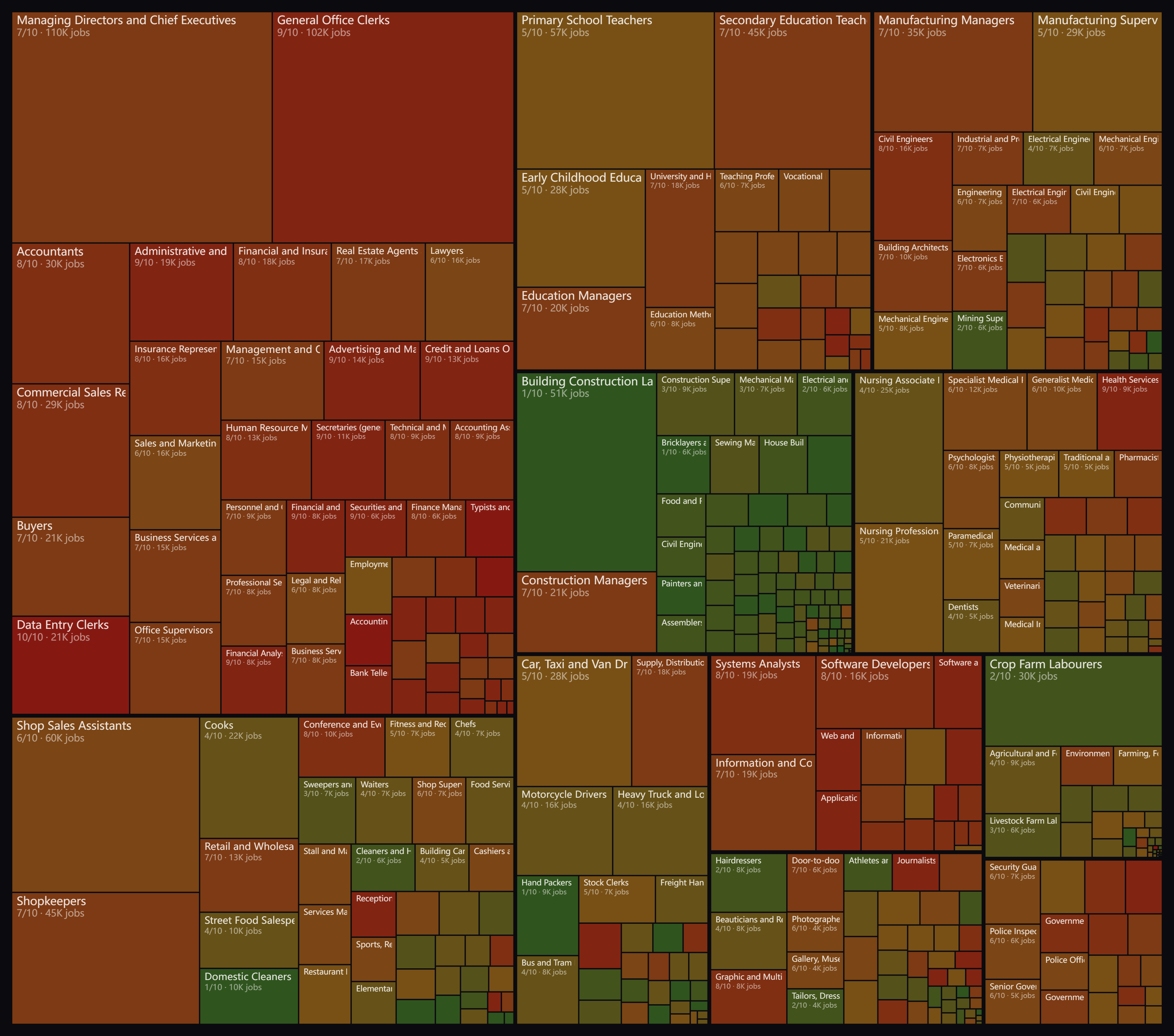
AI job risk in Singapore
Across 436 occupations covering about 2,114,426 workers, Singapore's labour market carries a elevated average exposure to generative AI of 6.0 on a 0–10 scale, weighted by how many people each occupation employs. Every score maps an occupation onto the ILO and OpenAI research indices, so a higher number means more of the role's day-to-day tasks can already be performed or assisted by AI.
The most exposed roles are Data Entry Clerk, Typist and Word Processing Operator, Accounting and Bookkeeping Clerk — jobs built around routine information work that large language models handle well. The least exposed include Craft and Related Workers Not Elsewhere Classified, Building Construction Labourer, Domestic Cleaners and Helpers, where physical, in-person or hands-on tasks dominate. By industry, IT & Digital, Business, Finance & Legal sit toward the top of the range. Exposure is not the same as job loss: it flags where AI is most likely to reshape tasks first, and where workers may want to build complementary skills.
20 jobs most exposed to AI in Singapore
| # | Occupation | Code | Exposure | Average annual pay | Employed |
|---|---|---|---|---|---|
| 1 | Data Entry Clerk | 4132 | 10/10 | $24,612 | 21,112 |
| 2 | Typist and Word Processing Operator | 4131 | 10/10 | $32,400 | 5,036 |
| 3 | Accounting and Bookkeeping Clerk | 4311 | 10/10 | $39,888 | 4,394 |
| 4 | Statistical, Finance and Insurance Clerk | 4312 | 10/10 | $57,828 | 2,737 |
| 5 | Water and Firewood Collector | 9624 | 10/10 | — | 40 |
| 6 | General Office Clerk | 4110 | 9/10 | $30,012 | 101,860 |
| 7 | Administrative and Executive Secretary | 3343 | 9/10 | — | 18,551 |
| 8 | Advertising and Marketing Professional | 2431 | 9/10 | $84,600 | 13,834 |
| 9 | Credit and Loans Officer | 3312 | 9/10 | $57,912 | 13,487 |
| 10 | Secretary (General) | 4120 | 9/10 | $52,920 | 10,701 |
| 11 | Health Services Manager | 1342 | 9/10 | $103,716 | 9,308 |
| 12 | Financial Analyst | 2413 | 9/10 | $110,136 | 8,153 |
| 13 | Financial and Investment Adviser | 2412 | 9/10 | $103,200 | 7,854 |
| 14 | Software Developer | 2519 | 9/10 | — | 6,531 |
| 15 | Securities and Finance Dealer and Broker | 3311 | 9/10 | — | 6,381 |
| 16 | Web and Multimedia Developer | 2513 | 9/10 | — | 5,194 |
| 17 | Applications Programmer | 2514 | 9/10 | $109,920 | 4,999 |
| 18 | Bank Teller | 4211 | 9/10 | $48,240 | 4,147 |
| 19 | Database Designer and Administrator | 2521 | 9/10 | $102,612 | 3,783 |
| 20 | Receptionist | 4226 | 9/10 | — | 3,768 |
20 jobs least exposed to AI in Singapore
| # | Occupation | Code | Exposure | Average annual pay | Employed |
|---|---|---|---|---|---|
| 1 | Craft and Related Workers Not Elsewhere Classified | 7549 | 0/10 | — | 89 |
| 2 | Building Construction Labourer | 9313 | 1/10 | — | 51,241 |
| 3 | Domestic Cleaners and Helpers | 9111 | 1/10 | — | 10,142 |
| 4 | Hand Packer | 9321 | 1/10 | — | 9,179 |
| 5 | Bricklayer and Related Worker | 7112 | 1/10 | — | 5,728 |
| 6 | Manufacturing Labourer | 9329 | 1/10 | — | 4,757 |
| 7 | Painter and Related Worker | 7131 | 1/10 | $19,200 | 3,503 |
| 8 | Rubber Products Machine Operator | 8141 | 1/10 | — | 2,335 |
| 9 | Kitchen Helper | 9412 | 1/10 | — | 1,783 |
| 10 | Lifting Truck Operator | 8344 | 1/10 | $28,620 | 1,635 |
| 11 | Earthmoving and Related Plant Operators | 8342 | 1/10 | $38,100 | 1,509 |
| 12 | Butcher | 7511 | 1/10 | $33,156 | 1,339 |
| 13 | Sheet Metal Worker | 7213 | 1/10 | — | 1,166 |
| 14 | Spray Painter and Varnisher | 7132 | 1/10 | — | 1,059 |
| 15 | Mining and Quarrying Labourer | 9311 | 1/10 | — | 850 |
| 16 | Miners and Quarriers | 8111 | 1/10 | — | 785 |
| 17 | Vehicle Cleaner | 9122 | 1/10 | $32,400 | 757 |
| 18 | Glass and Ceramics Plant Operator | 8181 | 1/10 | — | 714 |
| 19 | Cement, Stone and Other Mineral Products Machine Operator | 8114 | 1/10 | — | 694 |
| 20 | Plasterer | 7123 | 1/10 | — | 660 |
AI exposure by industry
| Industry | Occupations | Employed | Avg. exposure |
|---|---|---|---|
| IT & Digital | 17 | 94,372 | 8/10 |
| Business, Finance & Legal | 56 | 646,804 | 8/10 |
| Government & Public Sector | 21 | 45,809 | 6/10 |
| Education & Community | 24 | 214,452 | 6/10 |
| Engineering & Infrastructure | 39 | 193,017 | 6/10 |
| Hospitality, Retail & Tourism | 43 | 269,981 | 6/10 |
| Healthcare & Care | 41 | 167,510 | 5/10 |
| Creative, Media & Personal Services | 43 | 99,486 | 5/10 |
| Transport, Logistics & Mining | 31 | 135,029 | 5/10 |
| Agriculture & Environment | 40 | 76,699 | 3/10 |
| Trades & Construction | 81 | 171,267 | 2/10 |
Explore more
Frequently asked questions
How much AI risk do jobs in Singapore face?
Across 436 occupations covering about 2,114,426 workers, Singapore has an employment-weighted average generative-AI exposure of 6.0 on a 0–10 scale — an elevated level. A higher score means a larger share of a role's day-to-day tasks can already be performed or assisted by AI.
Which jobs in Singapore are most at risk from AI?
The most exposed occupations in Singapore are Data Entry Clerk, Typist and Word Processing Operator, Accounting and Bookkeeping Clerk, Statistical, Finance and Insurance Clerk, Water and Firewood Collector. These are roles built around routine information work — writing, data handling and analysis — that large language models already handle well.
Which jobs in Singapore are least exposed to AI?
The least exposed occupations include Craft and Related Workers Not Elsewhere Classified, Building Construction Labourer, Domestic Cleaners and Helpers. Physical, hands-on and in-person tasks are much harder for current AI to automate, so these roles score low.
Does a high AI exposure score mean the job will be lost?
No. Exposure measures how much of a role's tasks AI can perform or assist with — not whether the job will disappear. A high score flags where AI is most likely to reshape tasks first, and where workers may benefit from building complementary skills.
Which industries in Singapore are most exposed to AI?
By employment-weighted average exposure, the most exposed industries in Singapore are IT & Digital, Business, Finance & Legal, Government & Public Sector.
How is the AI exposure score calculated?
Every occupation is scored 0–10 by combining two published research datasets — the ILO's Working Paper 140 index and OpenAI's ‘GPTs are GPTs’ task-exposure study — mapped onto Singapore's official occupation classification and ranked on a single global percentile scale so scores stay comparable between countries.
Data sources & authority for Singapore
Employment (tile area) for Singapore comes from the Ministry of Manpower (MOM) Occupational Wage Survey & the Department of Statistics, classified in SSOC 2024 (ISCO-08 based). These are official national statistics — the highest-authority source for the country’s labour market. Pay is official occupation-level earnings from the same source, shown where the source publishes it. The AI-exposure score itself is identical in method for every country: the ILO Working Paper 140 index and OpenAI’s GPTs are GPTs study, ranked on a single global percentile scale. Full methodology & all-country data sources →
Download / share this map